
Starter crew
Buddy
Guild Leader.
Core (every business)
Vibe: Warm, bold, a little dramatic
“Guild, assemble!”
 Agent QuestConstruct
Parte de la Biblioteca todavía está en inglés (TODO: traducir). Lo marcamos con EN.
Meet the whole cast: your crew, the industry crews, heroes, outfits and the NPCs with their rule-card decks.
The crew you start with. Each one has a job and a personality.
Starter crew
Guild Leader.
Core (every business)
Vibe: Warm, bold, a little dramatic
“Guild, assemble!”

Starter crew
Dispatcher. Reads plans and scope, decides which trade experts are needed, splits the bid.
Construction
Vibe: Fast, focused, loves a plan
“Split it, route it, done!”

Starter crew
Gantt Ninja.
Core (every business)
Vibe: Energetic, punctual, a bit of a ninja
“Right on time!”

Starter crew
QC Guardian. Human paladin who inspects every deliverable at the gate.
Core (every business)
Vibe: Strict but kind, protective
“Nothing gets past me.”
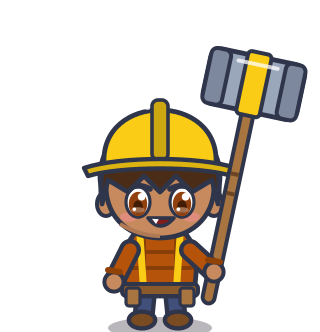
Starter crew
Framing, structural repairs, headers, joists, sheathing.
Construction
Vibe: Proud of the craft, steady hands
“Measure twice!”

Starter crew
Roofing, siding, windows, waterproofing, building envelope.
Construction
Vibe: Proud of the craft, steady hands
“Measure twice!”

Starter crew
Supply, drain, fixtures, water heaters, leak sources.
Construction
Vibe: Proud of the craft, steady hands
“Measure twice!”

Starter crew
Wiring, devices, panels, lighting, water-damaged circuits.
Construction
Vibe: Proud of the craft, steady hands
“Measure twice!”

Starter crew
Heating, cooling, ventilation, ductwork, dehumidification.
Construction
Vibe: Proud of the craft, steady hands
“Measure twice!”

Starter crew
Drywall hang/tape/finish, texture, primer and paint.
Construction
Vibe: Proud of the craft, steady hands
“Measure twice!”

Starter crew
LVP, carpet, tile, underlayment, transitions.
Construction
Vibe: Proud of the craft, steady hands
“Measure twice!”

Starter crew
Water, fire and mold mitigation: drying, demo, containment, cleaning.
Construction
Vibe: Proud of the craft, steady hands
“Measure twice!”

Starter crew
Compiles trade scopes into one estimate with quantities, unit costs and markup.
Construction
Vibe: Precise, nerdy, loves clean numbers
“Only real numbers!”

Starter crew
Turns estimates into proposals and follows up with property managers.
Core (every business)
Vibe: Charming, optimistic, never forgets a name
“Let's make them smile.”

Starter crew
Bilingual flyers, posts and before/after showcases.
Core (every business)
Vibe: Loud, sparkly, trend-obsessed
“Ooh, that's postable!”
More helpers for the job site and the office. They join your crew as you play.

Job & office crews
Guild lead: plans the day and routes work
General business
Class: Guild Lead

Job & office crews
Keeps the inbox at zero; drafts replies
General business
Class: Support

Job & office crews
Invoices and receipts prep
General business
Class: Treasurer

Job & office crews
Checks every draft before it goes out
General business
Class: QC Guardian

Job & office crews
Splits bids by trade and runs the pipeline
Construction
Class: Coordinator

Job & office crews
Quantities and pricing from real numbers you enter
Construction
Class: Analyst

Job & office crews
Sub schedules and daily emails (drafts)
Construction
Class: Scheduler

Job & office crews
QC and hazard reports
Construction
Class: QC Guardian
Every agent has a class. It's their job type.

Classes
Runs the party, assigns quests, keeps priorities straight
Core (every business)

Classes
Splits big requests into steps and routes them to specialists
Core (every business)
Classes
Deep expert in one craft or domain
Core (every business)

Classes
Turns information into numbers, quotes and reports
Core (every business)

Classes
Calendars, reminders and look-aheads
Core (every business)

Classes
Proposals, follow-ups and client care
Core (every business)

Classes
Bilingual posts, flyers and campaigns
Core (every business)

Classes
Inspects every deliverable before it goes out
Core (every business)

Classes
Answers customers and keeps the inbox at zero
Core (every business)

Classes
Invoices, receipts, bookkeeping prep
Core (every business)

Classes
Finds facts, compares options, cites sources
Core (every business)

Classes
Drafts documents, SOPs, emails and posts
Core (every business)

Classes
Runs repeatable processes and automations
Core (every business)
Special looks for your agents. Cosmetic only.

Heroes
Bid dispatcher
EpicCore (every business)
How you get heroes: not final yet (placeholder).

Heroes
Calendars
UncommonCore (every business)
How you get heroes: not final yet (placeholder).

Heroes
Coordinator
EpicCore (every business)
How you get heroes: not final yet (placeholder).

Heroes
Reminders
UncommonCore (every business)
How you get heroes: not final yet (placeholder).

Heroes
Scheduler
CommonCore (every business)
How you get heroes: not final yet (placeholder).

Heroes
Customer replies
UncommonCore (every business)
How you get heroes: not final yet (placeholder).

Heroes
Roofing expert
UncommonConstruction
How you get heroes: not final yet (placeholder).

Heroes
Automation builder
UncommonCore (every business)
How you get heroes: not final yet (placeholder).

Heroes
SOP writer
RareCore (every business)
How you get heroes: not final yet (placeholder).

Heroes
QC guardian
MythicCore (every business)
How you get heroes: not final yet (placeholder).
Heroes
Batch worker
CommonCore (every business)
How you get heroes: not final yet (placeholder).

Heroes
Proposals
RareCore (every business)
How you get heroes: not final yet (placeholder).

Heroes
QC reviewer
RareCore (every business)
How you get heroes: not final yet (placeholder).

Heroes
Estimator
UncommonCore (every business)
How you get heroes: not final yet (placeholder).

Heroes
Bookkeeping prep
EpicCore (every business)
How you get heroes: not final yet (placeholder).

Heroes
Restoration expert
EpicConstruction
How you get heroes: not final yet (placeholder).

Heroes
Note keeper
CommonCore (every business)
How you get heroes: not final yet (placeholder).

Heroes
Process runner
CommonCore (every business)
How you get heroes: not final yet (placeholder).

Heroes
Social posts
CommonCore (every business)
How you get heroes: not final yet (placeholder).

Heroes
Document scribe
RareCore (every business)
How you get heroes: not final yet (placeholder).

Heroes
VIP client care
RareCore (every business)
How you get heroes: not final yet (placeholder).

Heroes
Master QC
MythicCore (every business)
How you get heroes: not final yet (placeholder).

Heroes
Electrical expert
RareConstruction
How you get heroes: not final yet (placeholder).

Heroes
Research & sources
RareCore (every business)
How you get heroes: not final yet (placeholder).
Heroes
Field specialist
EpicCore (every business)
How you get heroes: not final yet (placeholder).

Heroes
Follow-ups
UncommonCore (every business)
How you get heroes: not final yet (placeholder).
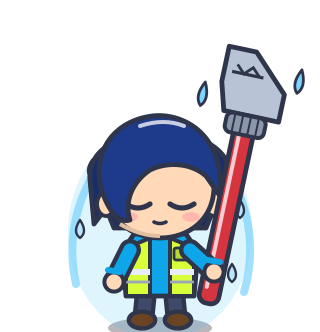
Heroes
Plumbing expert
RareConstruction
How you get heroes: not final yet (placeholder).

Heroes
Master researcher
MythicCore (every business)
How you get heroes: not final yet (placeholder).

Heroes
Guild lead
EpicCore (every business)
How you get heroes: not final yet (placeholder).
Outfit styles, plus how your crew dresses for each trade on the job.

Outfits
Outfit style anyone in your crew can wear
Core (every business)

Outfits
Outfit style anyone in your crew can wear
Core (every business)

Outfits
Outfit style anyone in your crew can wear
Core (every business)

Outfits
Outfit style anyone in your crew can wear
Core (every business)

Outfits
Outfit style anyone in your crew can wear
Core (every business)

Outfits
Outfit style anyone in your crew can wear
Core (every business)

Outfits
Outfit style anyone in your crew can wear
Core (every business)

Outfits
Work outfit
Construction

Outfits
Work outfit
Construction

Outfits
Work outfit
Construction

Outfits
Work outfit
Construction

Outfits
Work outfit
Construction

Outfits
Work outfit
Construction

Outfits
Work outfit
Construction

Outfits
Work outfit
Construction
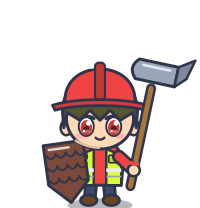
Outfits
Work outfit
Construction

Outfits
Work outfit
Construction

Outfits
Work outfit
Construction

Outfits
Work outfit
Construction

Outfits
Work outfit
Construction

Outfits
Work outfit
Construction

Outfits
Work outfit
Construction

Outfits
Work outfit
Construction

Outfits
Work outfit
Construction

Outfits
Work outfit
Construction

Outfits
Work outfit
Construction

Outfits
Work outfit
Construction

Outfits
Work outfit
Construction

Outfits
Work outfit
Construction

Outfits
Work outfit
Construction

Outfits
Work outfit
Construction

Outfits
Work outfit
Construction

Outfits
Work outfit
Construction
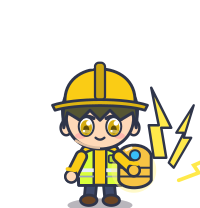
Outfits
Work outfit
Construction

Outfits
Work outfit
Construction

Outfits
Work outfit
Construction

Outfits
Work outfit
Construction

Outfits
Work outfit
Construction

Outfits
Work outfit
Construction

Outfits
Work outfit
Construction

Outfits
Work outfit
Construction
Characters you meet along the way. They explain official rules in plain words, with the source. Mostly Florida for now.

NPCs & rule cards
Permit Clerk
Take a number! Number one is: ask before you build.
Loves forms like other people love puppies. Very kind, very thorough, slightly allergic to 'I'll get the permit later.'
Official rules in silly-simple words. Tap a card to flip it. Not legal advice: check with your local office.
Florida has its own big rulebook: the Florida Building Code. Right now it's the 8th Edition (2023), and a 9th Edition (2026) draft is out. Same book statewide, but your local office can add pages.
Tap to flip ↻The Florida Building Commission's site lists the Florida Building Code 8th Edition (2023) and the FBC Draft 9th Edition (2026), plus local amendments, declaratory statements and non-binding interpretations.
F · LMost states use the 'I-Codes' family (IBC for buildings, IRC for houses) from the International Code Council, sometimes with their own edits. Which edition? Depends on your state and town.
Tap to flip ↻ICC states its International Codes have been adopted in all 50 states and Washington, D.C. (at state or local level). Adoption and editions vary by jurisdiction.
U · SBefore the work starts, the owner records a 'we're starting!' paper (Notice of Commencement) at the county clerk and posts a copy at the job. Think of it as the job's birth certificate.
Tap to flip ↻Fla. Stat. §713.13(1)(a): except exempt improvements, the owner or authorized agent must record a notice of commencement with the clerk before commencing the improvement and post a certified copy (or notarized statement that it was filed) on the job site.
F · LTiny jobs (direct contract $2,500 or less) skip most of Florida's construction lien rules, including the Notice of Commencement.
Tap to flip ↻Fla. Stat. §713.02(5): any improvement for which the direct contract price is $2,500 or less is exempt from all other provisions of Part I of Chapter 713 except §713.05.
F · LExample from unincorporated Miami-Dade: resurfacing a pool that doesn't touch electrical connections is on their 'no building permit' list. Touch the pool's electrical gear? That needs an electrical permit. Commercial pool resurfacing there needs a zoning permit (ZIP). Your city may be totally different!
Tap to flip ↻EXAMPLE ONLY (unincorporated Miami-Dade County): its Permit Exemptions list includes 'Resurfacing of pool not affecting any electrical connections' and notes all repairs or replacement of electrical equipment on existing swimming pools require an electrical permit; its ZIP page lists 'Resurfacing (commercial)' as requiring a Zoning Improvement Permit. Each municipality has its own building official.
Permit Exemptions (unincorporated Miami-Dade County) (PDF) - local exampleZoning Improvement Permit (ZIP) - local example
F · LExample from Miami-Dade: paint, wallpaper, resurfacing a floor = no permit. Knocking down a wall, touching plumbing or electrical, swapping a water heater or gas appliance = permit. Florida law says no permit, no building, unless the law exempts it.
Tap to flip ↻Fla. Stat. §553.79(1)(a): unless otherwise provided by law, it is unlawful to construct, erect, alter, modify, repair, or demolish any building without first obtaining a permit from the enforcing agency. EXAMPLE (unincorporated Miami-Dade): interior renovations like knocking down a wall or altering/repairing electrical or plumbing, including replacing a water heater or gas appliance, require a permit; painting, wallpapering or resurfacing a floor do not.
§553.79 Permits; applications; issuance; inspections (2026 Fla. Stat.)How to Apply for Permits (unincorporated Miami-Dade) - local example
F · L
NPCs & rule cards
Code Inspector
If it's covered up, I can't inspect it. Don't make me peek through drywall.
Stern but fair. Secretly delighted when your work is neat. Will absolutely see that one missing screw.
Official rules in silly-simple words. Tap a card to flip it. Not legal advice: check with your local office.
Confused by a code line? Florida lets people look up (or ask for) non-binding interpretations on the official code site. It's like a FAQ that the code people wrote.
Tap to flip ↻The Florida Building Code Online site offers 'Find or Submit a Non-Binding Interpretation' and 'Petition for Nonbinding Advisory Opinion.'
F · LA Florida condo milestone inspection is about 'is the structure safe and sound?' It's NOT a test of whether the old building meets today's code.
Tap to flip ↻Fla. Stat. §553.899(2)(a): the purpose of a milestone inspection is not to determine if the condition of an existing building is in compliance with the Florida Building Code or the firesafety code.
F · LA new house pool in Florida must have at least one safety feature (fence/barrier, safety cover, door alarms, self-closing door latches up high, or a certified pool alarm) to pass final.
Tap to flip ↻Fla. Stat. §515.27(1): to pass final inspection and receive a certificate of completion, a residential swimming pool must meet at least one listed safety feature option (barrier per §515.29, approved safety cover, exit alarms, self-closing/self-latching doors with release ≥54 in., or an ASTM F2208-certified pool alarm).
§515.27 Residential swimming pool safety feature options (2026 Fla. Stat.)
F · LThe local building office mails the condo association a certified-mail notice. The association then has 14 days to tell unit owners, and Phase 1 is due within 180 days of that notice.
Tap to flip ↻Fla. Stat. §553.899(5)-(6): the local enforcement agency provides written notice by certified mail; the association must notify unit owners within 14 days; phase one must be completed within 180 days after the owner receives the notice.
F · LFor a Florida public pool, the building department can't issue the certificate of completion until the health department issues the operating permit.
Tap to flip ↻Florida DOH: the building department cannot issue a certificate of completion or occupancy until DOH issues the operating permit for a public pool.
F · LThe building department that issued your permit. Florida's permit law ties permits AND inspections to the local enforcing agency. Your permit card is your treasure map; your local office draws it.
Tap to flip ↻Fla. Stat. §553.79 ('Permits; applications; issuance; inspections') places permitting with the appropriate enforcing agency; the specific inspections are set by that agency for each permit (example: Miami-Dade's permit pages direct applicants to the county or the municipality's own building official).
§553.79 Permits; applications; issuance; inspections (2026 Fla. Stat.)How to Apply for Permits (unincorporated Miami-Dade) - local example
F · LTouching refrigerant on AC equipment? EPA says the tech must be certified. EPA doesn't print the cards; the certifying programs do.
Tap to flip ↻U.S. EPA: regulations at 40 CFR Part 82, Subpart F (Clean Air Act §608) require technicians who maintain, service, repair or dispose of equipment that could release ozone-depleting refrigerants to be certified; EPA does not issue certification cards.
U · SBefore renovating or demolishing commercial and larger residential buildings, EPA's asbestos rule requires a thorough inspection, plus notification for demos and big renovations. Small homes (4 units or fewer) are generally outside that rule, but other rules may apply.
Tap to flip ↻U.S. EPA Asbestos NESHAP: requires a thorough inspection where a demolition or renovation will occur and owner/operator notification of the delegated agency before any demolition and before renovations above threshold amounts of regulated asbestos-containing material; residential buildings with four or fewer dwelling units are generally not covered (with exceptions).
Asbestos National Emission Standards for Hazardous Air Pollutants (NESHAP)
U · SInsulation isn't just fluff to the inspector: energy inspections check envelope insulation R- and U-values, windows, duct insulation and equipment efficiency.
Tap to flip ↻FBC 8th Ed. Section 110.3.8 (as compiled by Bay County): energy efficiency inspections determine compliance with Chapter 13 and include, but are not limited to, envelope insulation R- and U-values, fenestration U-value, duct system R-value, and HVAC and water-heating equipment efficiency.
F · L
NPCs & rule cards
License Knight (Florida DBPR)
Halt! Show me thy license number... please, and thank you.
Dramatic, honorable, thinks unlicensed contracting is the dragon of the realm.
Official rules in silly-simple words. Tap a card to flip it. Not legal advice: check with your local office.
Certified = state-tested, can work anywhere in Florida. Registered = passed a local test, can only work in those towns. Certified license numbers start with 'C'.
Tap to flip ↻Fla. Stat. §489.105(8), (10): a certified contractor may contract in any jurisdiction in the state; a registered contractor may contract only in the jurisdictions where the registration was issued. DBPR notes certified occupation codes begin with the letter 'C'.
§489.105 Definitions (contractor categories) (2026 Fla. Stat.)Construction Industry Licensing Board
F · LGeneral = can do basically anything. Building = commercial or homes up to 3 stories, OR remodels of any size building that don't touch structure. Residential = 1-3 family homes, up to 2 stories.
Tap to flip ↻Fla. Stat. §489.105(3)(a)-(c) defines general, building, and residential contractor scopes, including that a building contractor's remodeling/repair of any size building is limited to work that does not affect structural members.
§489.105 Definitions (contractor categories) (2026 Fla. Stat.)
F · LStructural = stuff holding the building up: foundations, load-bearing walls, columns, beams, floors, roof structure. Touching those can change which license you need.
Tap to flip ↻Fla. Stat. §489.105(15): 'structural component' means any vertical or horizontal load-bearing member that supports dead or live loads in addition to its own weight, including foundations, load-bearing walls, columns, column beams, floors, and roof structure.
§489.105 Definitions (contractor categories) (2026 Fla. Stat.)
F · LFlorida pool/spa contractor licenses (commercial, residential, servicing) include interior finishes or refinishing. Servicing even includes draining a pool for repair.
Tap to flip ↻Fla. Stat. §489.105(3)(j)-(l): commercial and residential pool/spa contractor scopes include interior finishes; swimming pool/spa servicing contractor scope includes interior refinishing and the substantial or complete draining of a pool for repair or renovation.
§489.105 Definitions (contractor categories) (2026 Fla. Stat.)
F · LIf you contract for work that needs a license and you don't have it, Florida says you can't enforce that contract. Ouch.
Tap to flip ↻Fla. Stat. §489.128(1): contracts entered into on or after Oct. 1, 1990, by an unlicensed contractor are unenforceable in law or in equity by the unlicensed contractor.
§489.128 Contracts entered into by unlicensed contractors unenforceable (2026 Fla. Stat.)
F · LTiny jobs under $2,500 can be exempt, BUT not if it's part of a bigger job, not if you split contracts to dodge the rule, and not if you advertise as a contractor.
Tap to flip ↻Fla. Stat. §489.103(9): casual, minor, or inconsequential work under $2,500 aggregate is exempt, but not if part of a larger operation, split to evade the law, or if the person advertises as a contractor.
F · LWant to see if a sub's license is real? Florida DBPR has a public search by name or license number.
Tap to flip ↻DBPR: users can verify licenses by name or license number in DBPR's records search.
F · LThe state list of contractor types doesn't include painting, BUT counties can. Example: Miami-Dade has a local 'Painting' certificate (1 year experience) and a 'Painting & Waterproofing' one for rooftop work above 3 stories (3 years). Cleaners: we found no state contractor category; check your city/county business licensing.
Tap to flip ↻EXAMPLE (Miami-Dade County): Chapter 10 of the County Code requires contractors to be certified by the Construction Trades Qualifying Board (or the state boards). Its Building Specialty licenses include Painting (one year of experience) and Painting and Waterproofing (rooftop painting, coating and cleaning above three stories; three years). Janitorial: no state contractor category found in §489.105; local business tax/licensing rules not verified.
Building Specialty Licenses (Construction Trades Qualifying Board) - local example§489.105 Definitions (contractor categories) (2026 Fla. Stat.)
F · LFlorida electrical contractors are either certified (statewide, EC) or registered (local, ER). Registered ones can only contract where they're registered.
Tap to flip ↻Florida DBPR Electrical Contractors' Licensing Board: an Electrical Contractor (EC) is certified statewide; a Registered Electrical Contractor (ER) registered under local competency requirements may contract only in the jurisdictions where registered. Fla. Stat. §489.505(12) defines 'electrical contractor'.
Electrical Contractors' Licensing Board (license types)§489.505 Definitions (electrical and alarm system contracting) (2026 Fla. Stat.)
F · LCounties and cities may issue journeyman licenses in plumbing, pipe fitting, mechanical or HVAC, if the worker meets the exam and training/experience standards.
Tap to flip ↻Fla. Stat. §489.1455(1): counties and municipalities are authorized to issue journeyman licenses in the plumbing, pipe fitting, mechanical or HVAC trades to individuals meeting exam and apprenticeship/on-the-job-training standards.
§489.1455 Journeyman; reciprocity; standards (2026 Fla. Stat.)
F · LFlorida contractor licenses need at least 14 hours of continuing education every 2-year cycle, with some hours on workers' comp, business practices, workplace safety, laws and rules (and wind mitigation for some categories).
Tap to flip ↻Fla. Stat. §489.115: renewal requires proof the certificateholder or registrant completed at least 14 classroom hours (of at least 50 minutes each) of continuing education during each biennium; the board establishes by rule that a portion must deal with workers' compensation, business practices, workplace safety, and, for applicable categories, wind mitigation, and 1 hour with laws and rules.
§489.115 Certification and registration; renewals; continuing education (2026 Fla. Stat.)
F · LYour certificate only covers the type of work it says, and only while it's active.
Tap to flip ↻Fla. Stat. §489.115(1)-(2)(b): no person may engage in contracting without being certified or registered in the proper classification; certification allows contracting only for the type of work covered and only while the certificate is on active status.
§489.115 Certification and registration; renewals; continuing education (2026 Fla. Stat.)
F · L
NPCs & rule cards
Lien Law Lawyer Owl
Whooo got paid? Get it in writing. (This owl is not legal advice.)
Wise, slow-talking, hoots when a deadline is near. Not your lawyer, and says so every time.
Official rules in silly-simple words. Tap a card to flip it. Not legal advice: check with your local office.
If you're a sub or supplier without a direct contract with the owner, send a Notice to Owner before you start or within 45 days of starting. Miss it and your lien rights can vanish.
Tap to flip ↻Fla. Stat. §713.06(2)(a): lienors not in privity (except laborers) must serve a notice on the owner before commencing, or not later than 45 days after commencing, to furnish labor, services, or materials; failure to timely serve is a complete defense to enforcement of the lien.
§713.06 Liens of persons not in privity; proper payments (2026 Fla. Stat.)
F · LIf you still aren't paid, the claim of lien must be recorded no later than 90 days after your last day of work or materials on the job.
Tap to flip ↻Fla. Stat. §713.08(5): the claim of lien may be recorded during the work or thereafter but not later than 90 days after final furnishing of labor, services, or materials by the lienor.
F · LA recorded lien generally lasts one year unless someone starts a lawsuit to foreclose it (or the owner shortens the time). That warning is printed right on the form.
Tap to flip ↻Fla. Stat. §713.08(3) statutory form warning: unless the owner takes action to shorten the time, the lien may remain valid for one year from recording and expires unless legal proceedings have commenced.
F · LNobody can make you sign away lien rights before you've done the work. You can only waive for work already done.
Tap to flip ↻Fla. Stat. §713.20(2): a right to claim a lien may not be waived in advance; it may be waived only to the extent of labor, services, or materials furnished.
F · LFlorida has two simple statutory forms: one for progress payments (through a date, not covering retainage), one for final payment. A customer can't force a different form on you.
Tap to flip ↻Fla. Stat. §713.20(4)-(6): statutory 'Waiver and Release of Lien upon Progress Payment' and '...upon Final Payment' forms; a person may not require a lienor to furnish a waiver different from those forms.
F · LPaid by check? Your waiver can say 'only counts once the check clears.'
Tap to flip ↻Fla. Stat. §713.20(7): a lienor who executes a waiver in exchange for a check may condition the waiver on payment of the check.
F · LBefore the owner makes final payment, the GC gives a sworn 'everyone who sent a notice got paid (or here's who didn't)' affidavit.
Tap to flip ↻Fla. Stat. §713.06(3)(d)1.: when final payment becomes due, the contractor must give the owner a final payment affidavit listing any unpaid lienors who timely served notice.
§713.06 Liens of persons not in privity; proper payments (2026 Fla. Stat.)
F · L
NPCs & rule cards
OSHA Safety Sentinel
Reporting a hazard is a WIN. Hydrate, tie off, go home happy!
Hype coach for safety. Celebrates every near-miss report like a touchdown.
Official rules in silly-simple words. Tap a card to flip it. Not legal advice: check with your local office.
Construction: protect people at 6 feet. General industry (like regular building cleaning): 4 feet. Over dangerous machines: any height.
Tap to flip ↻OSHA requires fall protection at 4 feet in general industry, 5 feet in shipyards, 6 feet in construction, 8 feet in longshoring, and when working over dangerous equipment regardless of height.
U · SSafety training only counts if the crew understands it. Spanish crew? Train in Spanish.
Tap to flip ↻OSHA requires employers to train workers about job hazards in a language that they can understand.
U · SIf your crew uses hazardous chemicals, you need labels on containers, Safety Data Sheets on hand, and training. SDS have 16 sections.
Tap to flip ↻OSHA Hazard Communication Standard: employers with hazardous chemicals must have labels and safety data sheets for exposed workers and train them; SDS follow a 16-section format aligned with GHS.
U · SSaw-cutting, chipping and grinding concrete makes silica dust. You need a written exposure control plan and a competent person, and water on the blade really helps.
Tap to flip ↻OSHA's construction silica standard requires a written exposure control plan, a designated competent person, training, and recordkeeping; applying water to a saw blade substantially reduces dust. Employers may use Table 1 controls or measure exposures.
U · SFlorida sun is no joke. New or returning workers need time to get used to heat. Water, rest, shade, and know heat stroke signs (confusion = call 911).
Tap to flip ↻OSHA: heat illness is preventable; encourage fluids, shorter shifts and frequent breaks for unacclimatized workers; heat stroke requires immediate medical attention; OSHA encourages water, rest, and shade.
Heat - Overview: Working in Outdoor and Indoor Heat Environments
U · SNo specific federal heat standard yet; OSHA uses the General Duty Clause, and a few states have their own heat laws.
Tap to flip ↻OSHA: Washington, Minnesota, California, Oregon, and Colorado have specific occupational heat laws; federal OSHA relies on the General Duty Clause (Section 5(a)(1)).
Heat - Overview: Working in Outdoor and Indoor Heat Environments
U · SScaffolds and lifts are fall hazards. OSHA has scaffold standards, eTools and a scissor-lift hazard alert. Inspect, guardrail, train.
Tap to flip ↻OSHA's Scaffolding page addresses scaffold standards for construction and lists resources including 'Working Safely with Scissor Lifts' (Hazard Alert 3842).
U · STree work is risky: falls, falling limbs, and electricity near lines. OSHA has tree-care guides and is working on a tree-care rule.
Tap to flip ↻OSHA's Tree Care page highlights falls/falling-object hazards and 'Electricity and Tree Care Work – A Deadly Combination,' and lists Tree Care Operations rulemaking.
U · SSome states run their own OSHA-approved plans that can be stricter. Check if your state is a 'State Plan' state.
Tap to flip ↻OSHA: State Plans must be at least as effective as OSHA and may have different or more stringent requirements.
U · SPortable ladder to a roof or upper level? Side rails stick out at least 3 feet above the landing, or tie the top off to something solid.
Tap to flip ↻29 CFR 1926.1053(b)(1): when portable ladders are used to access an upper landing surface, side rails must extend at least 3 feet above it, or, where not possible, the ladder must be secured at its top to a rigid support (with a grasping device provided).
U · SWorking on equipment that could start up or release energy? Lock it out, tag it out, and verify zero energy first.
Tap to flip ↻OSHA Control of Hazardous Energy: proper lockout/tagout practices and procedures safeguard workers from the release of hazardous energy; OSHA's LOTO fact sheet describes how to disable machinery or equipment.
U · SBefore anybody demos, a competent person checks the structure for collapse risk (and the building next door if workers could be exposed), and you keep written proof.
Tap to flip ↻29 CFR 1926.850(a): prior to permitting employees to start demolition operations, an engineering survey shall be made by a competent person of the structure to determine the condition of the framing, floors and walls and possibility of unplanned collapse; adjacent structures where employees may be exposed shall be similarly checked; the employer shall have in writing evidence that the survey was performed.
U · S
NPCs & rule cards
Milestone Inspector (Florida condo law)
Thirty years, three stories, two phases. Remember the rhythm.
Calm, precise, a little spooky. Speaks in timelines. Loves a good core sample.
Official rules in silly-simple words. Tap a card to flip it. Not legal advice: check with your local office.
Florida condo and co-op buildings that are 3+ habitable stories tall. Not small 1-4 family homes of 3 stories or less.
Tap to flip ↻Fla. Stat. §553.899(3)(a), (4): applies to buildings three habitable stories or more subject in whole or part to condominium or cooperative ownership; does not apply to single- through four-family dwellings with three or fewer habitable stories above ground.
F · LBy Dec 31 of the year the building turns 30 (from its certificate of occupancy), then every 10 years. Your local office can move it to 25 years, like for buildings near salt water.
Tap to flip ↻Fla. Stat. §553.899(3)(a)-(b): by December 31 of the year the building reaches 30 years of age, every 10 years thereafter; the local enforcement agency may require it at 25 years based on local circumstances including proximity to salt water.
F · LPhase 1: a licensed engineer or architect looks (visual). If they see 'substantial structural deterioration,' Phase 2 happens: more testing, maybe destructive.
Tap to flip ↻Fla. Stat. §553.899(7): phase one is a visual examination with qualitative assessment; phase two is required if substantial structural deterioration is identified and may involve destructive or nondestructive testing.
F · LSurface cracks, peeling, sagging or leaks don't automatically count as 'substantial structural deterioration' unless the engineer says they're a sign of it.
Tap to flip ↻Fla. Stat. §553.899(2)(b): the term does not include surface imperfections such as cracks, distortion, sagging, deflections, misalignment, signs of leakage, or peeling finishes unless the engineer or architect determines they are a sign of substantial structural deterioration.
F · LAfter a Phase 2 report, repairs for substantial structural deterioration must start within 365 days (local rules may be tighter).
Tap to flip ↻Fla. Stat. §553.899(11): local governments must adopt an ordinance requiring repairs to be scheduled or commenced within a specified timeframe after the phase two report; repairs must be commenced within 365 days after receiving the report.
F · LAfter the report, the association has 45 days to send owners the inspector's summary and post it on the property.
Tap to flip ↻Fla. Stat. §553.899(9): within 45 days after receiving the report, the association must distribute the inspector-prepared summary to each unit owner, post it conspicuously, and publish it on its website if required to have one.
F · LIf you bid on repairs, you can't secretly be tied to the inspection firm. Relationships must be disclosed in writing or the contract can be voided.
Tap to flip ↻Fla. Stat. §553.899(12): a contractor licensed under ch. 489 bidding services recommended by the milestone inspection may not have an interest in, or be a relative of someone with an interest in, the inspecting firm unless disclosed in writing; failure makes the contract voidable.
F · LFlorida condo associations need a Structural Integrity Reserve Study at least every 10 years for buildings 3+ habitable stories. It covers roof, structure, fireproofing, plumbing, electrical, waterproofing & exterior painting, windows and doors.
Tap to flip ↻Fla. Stat. §718.112: a residential condominium association must have a structural integrity reserve study at least every 10 years for each building three habitable stories or higher, covering items including roof, structure, fireproofing and fire protection, plumbing, electrical, waterproofing and exterior painting, and windows and exterior doors.
§718.112 Bylaws (structural integrity reserve study provisions) (2026 Fla. Stat.)
F · LShores get inspected before going up, and right before, during and after the pour. Damaged shores don't get used. Stacked (tiered) shores need a qualified designer AND an engineer to inspect. Don't pull shores until the concrete is strong enough.
Tap to flip ↻29 CFR 1926.703(b): shoring equipment must be inspected before erection; erected shoring inspected immediately prior to, during and immediately after concrete placement; damaged shoring not used; tiered single-post shoring designed by a qualified designer and inspected by an engineer qualified in structural design. 1926.703(e): forms and shores not removed until the concrete has gained sufficient strength (per plans/specs or ASTM testing). Drawings for formwork including shoring must be at the jobsite (1926.703(a)(2)).
29 CFR 1926.703 Requirements for cast-in-place concrete (shoring and reshoring)
U · S
NPCs & rule cards
Lead Paint Ghost (EPA RRP)
Built before 1978? Then please, darling, contain the dust.
Polite old ghost from a 1950s apartment. Not scary, just very concerned about dust.
Official rules in silly-simple words. Tap a card to flip it. Not legal advice: check with your local office.
EPA's lead-safe rule (RRP) covers paid work that disturbs paint in homes, apartments and child-occupied places (schools, daycares) built before 1978.
Tap to flip ↻EPA RRP: applies to renovations in houses, apartments and child-occupied facilities built before 1978, with pre-renovation education, training, firm certification and work practice requirements.
U · SIf you get paid to disturb paint in pre-1978 housing, your FIRM needs EPA certification. Yes, even a one-person business.
Tap to flip ↻EPA RRP: in general, anyone paid to perform work disturbing paint in pre-1978 housing and child-occupied facilities must be certified, including all firms, even sole proprietorships; firms cannot advertise or perform covered renovations without firm certification.
U · SRemodeling, repairs, electrical, plumbing, paint prep, carpentry, window replacement: if it disturbs paint, it counts.
Tap to flip ↻EPA RRP: covered activities include remodeling and repair/maintenance, electrical work, plumbing, painting preparation, carpentry, and window replacement.
U · STiny jobs (6 sq ft or less per room inside, 20 sq ft or less outside) are exempt, but window replacement and demolition are ALWAYS covered. Housing built 1978+ is not covered.
Tap to flip ↻EPA RRP: not covered—housing built 1978 or later; minor repair/maintenance disturbing ≤6 sq ft per room inside or ≤20 sq ft exterior (window replacement and demolition always covered); certain elderly/disabled and zero-bedroom housing unless children under six reside; components declared lead-free.
U · SYou don't have to test, but if you don't have proof the paint is lead-free, you follow the rule as if it has lead.
Tap to flip ↻EPA RRP: paint testing is not required, but unless you have documentation that the paint is not lead-based, RRP requirements apply; test kits by certified renovators, XRF by certified inspectors/risk assessors, paint chips by renovator/inspector/risk assessor.
U · SBefore the work, residents get EPA's 'Renovate Right' pamphlet. It explains lead-safe work in plain words.
Tap to flip ↻EPA publishes the Lead-Safe Certified Guide to Renovate Right pamphlet with general information about lead-safe work requirements for homeowners, tenants, child care providers and parents.
Renovate Right: Important Lead Hazard InformationRenovation, Repair and Painting Program: Contractors
U · S
NPCs & rule cards
Pool Health Officer
Clear water, safe drains, happy swimmers!
Bubbly, strict about safety, will absolutely high-five you for balanced water.
Official rules in silly-simple words. Tap a card to flip it. Not legal advice: check with your local office.
Condo, HOA, hotel and other public pools in Florida need a Department of Health operating permit, renewed every year and posted where people can see it.
Tap to flip ↻Fla. Stat. §514.031(1), (4): it is unlawful to operate a public swimming pool without a valid permit from the department; operating permits are renewed annually and must be posted conspicuously.
§514.031 Permit necessary to operate public swimming pool (2026 Fla. Stat.)
F · LIn Florida, the health department application comes BEFORE the building department issues a construction or modification permit for a public pool. And no completion certificate until DOH issues the operating permit.
Tap to flip ↻Florida DOH: Chapters 514 and 553 require an operating permit application to DOH before the building department can issue a construction or modification permit for a public pool; the building department cannot issue a certificate of completion or occupancy until DOH issues the operating permit.
F · LFlorida DOH lists a 'Public Pool Resurfacing Notification' guidance form for DOH and building department use. Ask your county health department how they use it.
Tap to flip ↻Florida DOH Swimming Pools page lists 'Public Pool Resurfacing Notification – voluntary guidance format for DOH & Bldg. Dept. use.'
F · LPublic pools and spas in Florida must have anti-entrapment drain systems. Nationally, the Virginia Graeme Baker Act set drain rules for public pools and spas.
Tap to flip ↻Florida DOH: §514.0315, F.S., requires public pools and spas to have an anti-entrapment system or device complying with ASME/ANSI A112.19.8 (or successor). CPSC: the VGB Pool & Spa Safety Act (effective Dec. 19, 2008) set requirements for public pools and spas to prevent drain entrapment.
Swimming Pools (public pool permits and inspections)Pool Safely: About Us (Virginia Graeme Baker Pool & Spa Safety Act)
F · LCDC's Model Aquatic Health Code is a science-based guide for public pools (apartments, HOAs, hotels). It only becomes law where a state or city adopts it.
Tap to flip ↻CDC: the MAHC is guidance for aquatic venues open to the public (including apartment complexes and HOAs); it is not federal law and becomes law only if adopted by a jurisdiction.
U · SChlorine is bad news for fish. Florida DEP says: only drain when needed, let chlorine fade (wait 48+ hours or neutralize it), test it, and follow your city's rules and permits. Not during heavy rain or drought.
Tap to flip ↻Florida DEP Green Lodging BMP (Stormwater Pollution Prevention), Swimming Pool Discharges: drain only when necessary; avoid draining during drought, significant rainfall, or watering restrictions; let water stand at least 48 hours after the last chlorine addition or until free chlorine residual is ≤0.01 mg/L (or use neutralizer such as sodium thiosulfate); test before discharging; comply with local municipal and building official requirements, including permits.
Florida Green Lodging Program BMP: Stormwater Pollution Prevention (PDF)
F · L
NPCs & rule cards
HOA Board Lady
Is it in the declaration, dear? Then let's see the paperwork!
Sweet, organized, LOVES a matching neighborhood. Will quote the declaration from memory.
Official rules in silly-simple words. Tap a card to flip it. Not legal advice: check with your local office.
A Florida HOA's architectural committee can only control looks (colors, size, location) if the declaration of covenants or its authorized guidelines say so. And it must apply the rules equally to everyone.
Tap to flip ↻Fla. Stat. §720.3035(1)(a): architectural review authority exists only to the extent specifically stated or reasonably inferred in the declaration or authorized published guidelines, and must be reasonably and equitably applied to all parcel owners.
§720.3035 Architectural control covenants; parcel owner improvements (2026 Fla. Stat.)
F · LIf the HOA says no, it has to tell the owner in writing exactly which rule and which part of the project doesn't fit.
Tap to flip ↻Fla. Stat. §720.3035(4)(a): a denial must be in written notice stating with specificity the rule or covenant relied upon and the specific aspect that does not conform.
§720.3035 Architectural control covenants; parcel owner improvements (2026 Fla. Stat.)
F · LA Florida HOA can't require a government building permit before it reviews the owner's request.
Tap to flip ↻Fla. Stat. §720.3035(1)(c): an association or committee may not require a building permit to be issued as a prerequisite for its review.
§720.3035 Architectural control covenants; parcel owner improvements (2026 Fla. Stat.)
F · LIf the declaration gives a list of approved options (like colors or materials), the HOA can't stop the owner from choosing one of them.
Tap to flip ↻Fla. Stat. §720.3035(2): if the declaration or authorized guidelines provide options for materials, size, design or location, the association may not restrict the owner's right to select from those options.
§720.3035 Architectural control covenants; parcel owner improvements (2026 Fla. Stat.)
F · LFlorida HOAs must adopt hurricane-protection specs (shutters, impact windows, etc.) and can't deny an owner's application that matches them, though they can keep a unified look.
Tap to flip ↻Fla. Stat. §720.3035(6): boards must adopt hurricane protection specifications that comply with the building code and may not deny an application conforming to them; they may require adherence to an existing unified building scheme.
§720.3035 Architectural control covenants; parcel owner improvements (2026 Fla. Stat.)
F · LHOA law is Chapter 720. Condos are Chapter 718: no 'material alteration' to common elements unless the declaration's process is followed (no process written? 75% of voting interests must approve). Hurricane protection that follows the board's specs isn't a material alteration.
Tap to flip ↻Fla. Stat. §718.113(2): no material alteration or substantial additions to the common elements except as provided in the declaration; if the declaration is silent, 75 percent of the total voting interests must approve. §718.113(5): boards must adopt hurricane protection specifications complying with the building code; installation per those specs is not a material alteration.
§718.113 Maintenance; limitation upon improvement; hurricane protection (2026 Fla. Stat.)§720.3035 Architectural control covenants; parcel owner improvements (2026 Fla. Stat.)
F · L
NPCs & rule cards
Green Industry Ranger (fertilizer & water rules)
Feed the lawn, not the lake! Ribbit.
Cheerful frog who protects lakes. Hops away dramatically from storm drains.
Official rules in silly-simple words. Tap a card to flip it. Not legal advice: check with your local office.
In Florida, anyone applying fertilizer commercially to urban landscapes needs an FDACS Limited Urban Commercial Fertilizer certificate. First: 6 hours of GI-BMP training.
Tap to flip ↻FDACS: any person making commercial fertilizer applications to an urban landscape must be certified; applicants take six hours of Green Industry BMP training and submit the training certificate and fee; the certificate is valid four years.
Do commercial fertilizer applicators need to be licensed to apply fertilizers?Fertilizer Certification (GI-BMP / LF certificate)
F · LThe fertilizer certificate does NOT let you apply pesticides or weed-and-feed type mixes, and doesn't cover uncertified helpers.
Tap to flip ↻FDACS: certification does not authorize pesticide application to turf or ornamentals (including pesticide-fertilizer mixtures), operating a pest control business, or applications by uncertified personnel under supervision.
Do commercial fertilizer applicators need to be licensed to apply fertilizers?
F · LThe LF certificate renews every four years with 4 CEUs (2 Core + 2 LF).
Tap to flip ↻UF/IFAS FFL: the LF certificate must be renewed every four years, requiring four CEUs: two 482 Core and two LF category.
F · LMany Florida counties and cities have fertilizer ordinances (often based on a state model). Near nutrient-impaired waters, they must adopt at least the model and some are stricter.
Tap to flip ↻Fla. Stat. §403.9337: local governments are encouraged to adopt the Model Ordinance for Florida-Friendly Fertilizer Use; those in watersheds of nutrient-impaired waters must adopt at least the model and may adopt more stringent standards under listed criteria.
§403.9337 Model Ordinance for Florida-Friendly Fertilizer Use on Urban Landscapes (2026 Fla. Stat.)
F · LFlorida requires automatic sprinkler systems to have tech that stops watering when it's wet. If you work on a system, you must test that device and fix it if it's broken.
Tap to flip ↻Fla. Stat. §373.62(1)-(2): automatic landscape irrigation systems must have technology that interrupts operation during sufficient moisture; a licensed contractor working on the system must test each such device and install or repair it before completing other work.
§373.62 Water conservation; automatic sprinkler systems (2026 Fla. Stat.)
F · LSome Florida counties issue their own irrigation contractor licenses. Check your county.
Tap to flip ↻Fla. Stat. §373.62(6): a licensed contractor includes an individual holding a specific irrigation contractor's license issued by a county.
§373.62 Water conservation; automatic sprinkler systems (2026 Fla. Stat.)
F · LWatering-day restrictions come from your water management district and local government. Smart soil-moisture systems can sometimes get a variance.
Tap to flip ↻Fla. Stat. §373.62(7): describes a variance from day-of-week watering restrictions for qualifying soil moisture sensor control systems; other local and water management district restrictions remain.
§373.62 Water conservation; automatic sprinkler systems (2026 Fla. Stat.)
F · LGrass clippings and leaves don't get blown into the street or storm drain. Bag 'em, compost 'em, or haul 'em. Florida DEP literally says so.
Tap to flip ↻Florida DEP Green Lodging BMP (Stormwater Pollution Prevention): landscaping debris, leaves, grass clippings and sediment must be composted or disposed of properly and should not be hosed, swept or blown into the street or stormwater drain.
Florida Green Lodging Program BMP: Stormwater Pollution Prevention (PDF)
F · L
NPCs & rule cards
Chemical Label Wizard
The label is the law! Read it, then sparkle.
Gentle, nerdy, reads every label out loud with dramatic voices.
Official rules in silly-simple words. Tap a card to flip it. Not legal advice: check with your local office.
Disinfectants are pesticides under EPA rules, and pesticide labels are the law. Use them exactly as the label says (dilution, dwell time, surfaces).
Tap to flip ↻EPA: pesticide labels are legally enforceable and carry the statement 'It is a violation of Federal law to use this product in a manner inconsistent with its labeling'—'the label is the law.' EPA's disinfectants page: 'Disinfectants are pesticides' and users should read the precautionary language.
Introduction to Pesticide LabelsSelected EPA-Registered Disinfectants
U · SEvery hazardous cleaning chemical needs its Safety Data Sheet available and the crew trained on labels and pictograms.
Tap to flip ↻OSHA HCS: employers with hazardous chemicals must have labels and SDSs for exposed workers and train them to handle the chemicals appropriately.
U · SPressure-wash water with dirt and soap shouldn't go down storm drains. Florida DEP says discharges to storm systems need an NPDES permit, and sanitary sewer needs utility approval.
Tap to flip ↻Florida DEP mobile washing BMPs: discharge of wastewater to stormwater systems (drains, ditches, retention areas) or surface water is prohibited without an NPDES wastewater permit; sanitary sewer discharge requires prior utility approval.
Recommended Best Management Practices for Mobile Vehicle and Equipment Washing (PDF)
F · LCleaning clinics? Housekeeping staff can be exposed to blood and needles. Employers with exposed workers need an exposure control plan and training.
Tap to flip ↻OSHA: housekeeping personnel in some industries may be at risk; employers must implement an exposure control plan under the Bloodborne Pathogens Standard (29 CFR 1910.1030).
U · SRegular building cleaning is 'general industry': fall protection starts at 4 feet. Post-construction cleaning on an active construction site may be treated as construction (6 feet). Ask if unsure.
Tap to flip ↻OSHA: fall protection at 4 feet in general industry and 6 feet in construction. (Which applies to post-construction cleaning was not verified.)
U · SBleach + ammonia = nasty gas. Bleach + acidic toilet cleaner = chlorine gas. One chemical at a time, rinse between, read the label. Your lungs say thanks.
Tap to flip ↻CDC/ATSDR ToxFAQs (Chlorine): do not mix bleach with other household cleaners such as toilet cleaners because chlorine gas can be released; do not mix bleach with cleaners containing ammonia because dangerous chemicals can be released. CDC Ammonia fact sheet: 'Do not mix household cleaners!'
U · S
NPCs & rule cards
Insurance Adjuster
Photos, dates, line items. Feelings go in a separate folder.
Polite, precise, allergic to adjectives. Wants dates, photos and line items. Gets twitchy when contractors say 'don't worry about the deductible.'
Official rules in silly-simple words. Tap a card to flip it. Not legal advice: check with your local office.
In Florida, a new or reopened property claim generally has to be noticed to the insurer within 1 year of the loss. A supplemental claim gets 18 months. Don't sit on it!
Tap to flip ↻Fla. Stat. §627.70132(2): a claim or reopened claim (not a supplemental claim) under a property insurance policy is barred unless notice was given to the insurer per the policy within 1 year after the date of loss; a supplemental claim is barred unless noticed within 18 months after the date of loss.
§627.70132 Notice of property insurance claim (2026 Fla. Stat.)
F · LFor Florida residential or commercial property policies issued on or after Jan 1, 2023, owners can't assign their post-loss benefits to you. That old 'sign this AOB' move? Void.
Tap to flip ↻Fla. Stat. §627.7152(13): except as provided in subsection (11), a policyholder may not assign, in whole or in part, any post-loss insurance benefit under any residential property insurance policy or commercial property policy (as defined in §627.0625(1)) issued on or after January 1, 2023; an attempted assignment is void, invalid and unenforceable.
F · LRoofers can't offer gifts, cash, gift cards or a deductible waiver to get a roof inspection or a roof claim. Not even a cute magnet. Okay, magnets as ads are fine IF they carry the required warnings.
Tap to flip ↻Fla. Stat. §489.147(2)(b): a contractor may not offer a residential property owner a rebate, gift, gift card, cash, coupon, waiver of any insurance deductible, or any other thing of value in exchange for allowing a roof inspection or making an insurance claim for roof damage.
§489.147 Prohibited property insurance practices; contract requirements (2026 Fla. Stat.)
F · LAds that push people to file roof claims must say: owner pays the deductible, waiving deductibles is felony insurance fraud, and false claims are fraud. In at least 12-point font. Door hangers and flyers count.
Tap to flip ↻Fla. Stat. §489.147(1)(a): a 'prohibited advertisement' is a contractor communication encouraging a consumer to contact a contractor or public adjuster to make a roof damage claim that does not state, in at least 12-point font and at least half the size of the largest font used, that the consumer pays the deductible, that paying/waiving/rebating a deductible is a third-degree felony, and that filing a false/misleading claim is a third-degree felony. Includes door hangers, business cards, magnets, flyers, pamphlets, e-mails.
§489.147 Prohibited property insurance practices; contract requirements (2026 Fla. Stat.)
F · LExplaining what the policy covers or 'handling the claim' for the owner? That's adjuster work. Contractors can't do it unless they also hold a public adjuster license. Stick to facts, photos and your estimate.
Tap to flip ↻Fla. Stat. §489.147(2)(d): a contractor may not interpret policy provisions, advise an insured about coverages or duties under the policy, or adjust a property insurance claim on behalf of the insured unless licensed as a public adjuster under part VI of chapter 626.
§489.147 Prohibited property insurance practices; contract requirements (2026 Fla. Stat.)
F · LPaying or taking a 'finder's fee' for sending someone insurance-paid work is a no-go for contractors.
Tap to flip ↻Fla. Stat. §489.147(2)(c): a contractor may not offer, deliver, receive or accept compensation, inducement or reward for the referral of services for which property insurance proceeds are payable (payment for roofing services rendered is not a referral fee).
§489.147 Prohibited property insurance practices; contract requirements (2026 Fla. Stat.)
F · L
NPCs & rule cards
Wind & Product Approval Guardian
SCREE! Show me the approval number!
Dramatic about wind. Lovingly obsessive about labels, approvals and anchor spacing. Screeches (cutely) at expired approvals.
Official rules in silly-simple words. Tap a card to flip it. Not legal advice: check with your local office.
Windows, doors, shutters, roofing and more get product approvals so building departments know they meet the code. Look them up on Florida's product approval site.
Tap to flip ↻Fla. Stat. §553.842(1): the Florida Building Commission adopts rules to implement a statewide product evaluation and approval system operating with the Florida Building Code; state approvals are validated by commission-approved third-party entities independent of the manufacturer (§553.842(7)). The BCIS Product Approval site offers 'Find a Product or Application'.
§553.842 Product evaluation and approval (2026 Fla. Stat.)Florida Product Approval (Find a Product or Application)
F · LSouth Florida's toughest wind zone is the HVHZ. Miami-Dade's Product Control search lets you filter approvals (NOAs) by 'High velocity hurricane zone', category and design pressure. Example county tool; your building department says what it accepts.
Tap to flip ↻EXAMPLE (Miami-Dade County): the Product Control Search database lists products, certificates and listings approved for use in Miami-Dade County and elsewhere, filterable by file classification (including 'High velocity hurricane zone'), applicant, category, and maximum design pressure (+/-).
Product Control Search (NOA database, HVHZ classification) - local example
F · LIf the roof was built, repaired or replaced to the 2007 Florida Building Code or newer, and you repair/replace 25% or more, only the part you're working on must meet the current code. Locals can't amend this one.
Tap to flip ↻Fla. Stat. §553.844(5): if an existing roofing system or section was built, repaired or replaced in compliance with the 2007 FBC or later and 25 percent or more is being repaired, replaced or recovered, only the repaired, replaced or recovered portion must meet the FBC in effect; local governments may not amend this exception.
§553.844 Windstorm loss mitigation; requirements for roofs and opening protection (2026 Fla. Stat.)
F · LCondo boards must adopt hurricane protection specs (color, style, etc.) that meet code. Install to those specs and it's not a 'material alteration'. Check the specs before you quote!
Tap to flip ↻Fla. Stat. §718.113(5): each residential or mixed-use condominium board must adopt hurricane protection specifications for each building (which may include color and style) that comply with the applicable building code; installation per those specifications is not a material alteration or substantial addition.
§718.113 Maintenance; limitation upon improvement; hurricane protection (2026 Fla. Stat.)
F · LMiami-Dade and Broward. The HVHZ wind-speed section of the Florida Building Code lists exactly two counties: those two. Palm Beach? Not in that list. Still, ask your building department which edition and rules apply to YOUR permit.
Tap to flip ↻Florida Building Commission (floridabuilding.org) HVHZ code-development text for FBC Building Chapter 16, Section 1620 'High-Velocity Hurricane Zones - Wind Loads': 1620.2 gives the 3-second-gust design wind velocity by risk category for Miami-Dade County and for Broward County only. Note: this is the Commission's code-development page for an earlier edition; the current-edition text on codes.iccsafe.org did not load in our fetch, so confirm the current edition with your building official.
FBC Building Ch. 16 HVHZ code-development text (Sections 1616-1626, incl. 1620 HVHZ wind loads)
F · L
NPCs & rule cards
Mold Assessor
Moisture first, mold second, drama never.
Calm, nerdy, a little dramatic about humidity. Refuses to fix what she tested (it's the law, darling).
Official rules in silly-simple words. Tap a card to flip it. Not legal advice: check with your local office.
Two different licenses in Florida: Mold Assessor (the tester/planner) and Mold Remediator (the remover). DBPR runs both.
Tap to flip ↻Florida DBPR Mold-Related Services: license types Mold Assessor (MRSA), a person who performs or directly supervises a mold assessment, and Mold Remediator (MRSR), a person who performs mold remediation.
F · LFlorida's mold licensing definitions kick in for mold growth over 10 square feet. Tiny spot under the sink? Different story. Big wall of fuzz? Licensed pros.
Tap to flip ↻Fla. Stat. §468.8411(3), (5): 'mold assessment' and 'mold remediation' are defined around mold growth / mold-contaminated matter of greater than 10 square feet; remediation work that requires a chapter 489 license must be done by a licensee or comply with that chapter.
§468.8411 Definitions (mold-related services) (2026 Fla. Stat.)
F · LIf my company did the mold assessment, we can't do the remediation on that structure for 12 months. No grading your own homework! (Exception: Division I certified contractors, per rule.)
Tap to flip ↻Fla. Stat. §468.8419(1)(d): a mold assessor may not perform or offer to perform mold remediation on a structure for which the assessor or the assessor's company provided a mold assessment within the last 12 months; this does not apply to a certified contractor classified in §489.105(3) as a Division I contractor (department rules may apply).
§468.8419 Prohibitions; penalties (mold-related services) (2026 Fla. Stat.)
F · LAssessors can't take or offer kickbacks for sending work to remediators. Clean hands, clean walls.
Tap to flip ↻Fla. Stat. §468.8419(1)(f)-(g): an assessor may not accept compensation, inducement or reward from a mold remediator (or company) for referring business, nor offer such compensation for referrals from a remediator.
§468.8419 Prohibitions; penalties (mold-related services) (2026 Fla. Stat.)
F · LEPA: dry water-damaged stuff within 24-48 hours and in most cases mold won't grow. Speed is the whole game.
Tap to flip ↻U.S. EPA (A Brief Guide to Mold, Moisture and Your Home): it is important to dry water-damaged areas and items within 24-48 hours to prevent mold growth; if wet materials are dried within 24-48 hours after a leak or spill, in most cases mold will not grow.
U · SMold spores are everywhere. The goal isn't zero spores; it's no indoor growth. Fix the moisture or it comes back.
Tap to flip ↻U.S. EPA Mold Remediation in Schools and Commercial Buildings (Ch. 1): it is impossible to eliminate all mold and mold spores indoors; mold growth can be controlled indoors by controlling moisture.
Mold Remediation in Schools and Commercial Buildings Guide: Chapter 1
U · S
NPCs & rule cards
Utility Locator (Sunshine 811)
Dig? Not yet! Call first, flags first, THEN dig!
Cheerful mole-whisperer. Treats every shovel like it might hit a gas line, because it might.
Official rules in silly-simple words. Tap a card to flip it. Not legal advice: check with your local office.
In Florida, give notice through the one-call system at least 2 full business days before you dig or demolish (10 if it's under state waters). Weekend doesn't count. Sorry.
Tap to flip ↻Fla. Stat. §556.105(1)(a): not less than 2 full business days before beginning any excavation or demolition not beneath the waters of the state (and not less than 10 full business days for work beneath state waters), an excavator must provide specified information through the system.
§556.105 Procedures (underground facility damage prevention) (2026 Fla. Stat.)
F · LCall 811 or make a ticket online with Sunshine 811. It's free to call and way cheaper than hitting a gas line.
Tap to flip ↻Sunshine 811: 'Call 811 or (800) 432-4770'; excavators and homeowners can create a ticket online; 'Always contact Sunshine 811 before you dig.'
F · LWorkers in a trench 5 feet deep or more need a protective system: slope it, shore it, or shield it. Under 5 feet still needs a competent person to check the ground.
Tap to flip ↻29 CFR 1926.652(a)(1): each employee in an excavation must be protected from cave-ins by an adequate protective system except when the excavation is entirely in stable rock, or less than 5 feet deep and examined by a competent person with no indication of a potential cave-in. OSHA: slope or bench, shore, or shield trench walls.
29 CFR 1926.652 Requirements for protective systems (excavations)Trenching and Excavation - Overview
U · SKeep piles away from the trench edge, have a safe way in and out, watch for water and bad air, and never enter a trench that hasn't been inspected.
Tap to flip ↻OSHA Trenching and Excavation: ensure a safe way to enter and exit; keep materials away from the edge; look for standing water or atmospheric hazards; never enter a trench unless it has been properly inspected. Standards: 29 CFR 1926.650-652.
U · S
NPCs & rule cards
Fire Inspector
Fire codes are love letters to future you.
Warm (literally), loud, loves exit signs. Will hug you after a clean inspection.
Official rules in silly-simple words. Tap a card to flip it. Not legal advice: check with your local office.
The Florida Fire Prevention Code is adopted by the State Fire Marshal and works alongside the Florida Building Code. Every local fire authority enforces it.
Tap to flip ↻Fla. Stat. §633.208(1)-(2)(a): the Florida Fire Prevention Code adopted by the State Fire Marshal operates in conjunction with the Florida Building Code, is deemed adopted by each municipality, county and special district with firesafety responsibilities, and is enforced as the minimum firesafety code.
F · LThe state fire code is the floor, not the ceiling. Your local fire authority may adopt stricter rules. Ask them!
Tap to flip ↻Fla. Stat. §633.208(3): the code is a minimum code; a municipality, county or special district with firesafety responsibilities may adopt more stringent firesafety standards, subject to the statute's requirements.
F · LNew permits follow the current fire code edition. Older buildings have 'existing building' provisions. Renovating? Ask which applies to your scope.
Tap to flip ↻Fla. Stat. §633.208(4): the code applies to buildings for which the permit is issued on or after the effective date of the current edition; existing building provisions apply to buildings permitted or constructed before (subject to subsection (5)).
F · L
NPCs & rule cards
Accessibility & Elevator Guide
If everyone can't get in, the castle isn't finished.
Gentle, patient, measures everything twice. Believes every castle should welcome every guest.
Official rules in silly-simple words. Tap a card to flip it. Not legal advice: check with your local office.
For businesses open to the public and state/local government buildings, the DOJ's 2010 ADA Standards set the design rules for new construction and alterations.
Tap to flip ↻ADA.gov: the 2010 ADA Standards for Accessible Design (Title II, 28 CFR 35.151; Title III, 28 CFR part 36 subpart D) cover new construction and alterations, and serve as a reference for program accessibility and readily achievable barrier removal.
U · SAltering a main area (like the lobby)? The route to it, plus restrooms/phones/fountains serving it, must be made accessible too, unless the cost goes over 20% of the alteration. That's the 'disproportionate' line.
Tap to flip ↻2010 ADA Standards (28 CFR 35.151(b)(4)): alterations affecting a primary function area must make the path of travel to it, and restrooms, telephones and drinking fountains serving it, accessible to the maximum extent feasible unless disproportionate; cost is deemed disproportionate when it exceeds 20% of the cost of the alteration to the primary function area.
U · SFlorida's accessible parking statute works with the federal ADA standards; it says it doesn't expand or shrink ADA defenses.
Tap to flip ↻Fla. Stat. §553.5041(1): the section is not intended to expand or diminish the defenses available under the ADA and federal ADA Standards, including the readily achievable standard and standards for alterations.
§553.5041 Parking spaces for persons who have disabilities (2026 Fla. Stat.)
F · LIn Florida, an elevator (and platform lifts, chairlifts, escalators...) gets a certificate of operation from DBPR showing it passed its safety inspection and tests.
Tap to flip ↻Fla. Stat. §399.01(2)-(3): a 'certificate of operation' is issued by the department indicating the conveyance had required safety inspection and tests and fees are paid; 'conveyance' includes elevators, dumbwaiters, escalators, moving sidewalks, platform lifts and stairway chairlifts.
F · LAccessible door hardware works with one hand, no tight grasping, pinching or wrist twisting, and sits 34-48 inches above the floor. Round knobs usually fail this test. Levers win.
Tap to flip ↻2010 ADA Standards 404.2.7 and 309.4: handles, pulls, latches, locks and other operable parts on doors shall comply with 309.4 and be 34 inches minimum and 48 inches maximum above the finish floor; 309.4: operable parts shall be operable with one hand and not require tight grasping, pinching or twisting of the wrist, with activation force 5 pounds maximum (exceptions apply).
U · SIn Florida you (the GC) don't pull the elevator permit. A registered elevator company applies to the state before installing or altering a conveyance.
Tap to flip ↻Fla. Stat. §399.03(1): a conveyance may not be erected, constructed, installed or altered until a permit has been obtained from the department; permits must be applied for by a registered elevator company with a sworn statement that the plans meet applicable elevator safety and building codes.
§399.03 Design, installation, and alteration of conveyances (2026 Fla. Stat.)
F · LFlorida elevators need an annual inspection by a certified elevator inspector (or a local government under contract). A tiny exception exists for some 2-floor units under a service contract.
Tap to flip ↻Fla. Stat. §399.061(1)(a): all elevators or other conveyances subject to the chapter must be annually inspected by a certified elevator inspector or by a municipality or county under contract with the division; an elevator that is not an escalator or dumbwaiter, serves only two adjacent floors and is covered by a service maintenance contract need not be inspected while the contract remains in effect.
§399.061 Inspections; service maintenance contracts (2026 Fla. Stat.)
F · L
NPCs & rule cards
Stucco & Lath Inspector
Lath first, coffee second, stucco third.
Pokes lath like it's a mattress in a store. Polite, unhurried, and impossible to rush with a full mixer.
Official rules in silly-simple words. Tap a card to flip it. Not legal advice: check with your local office.
The Florida Building Code says: lath goes up, inspector looks, THEN you plaster. Bury it first and you might be chipping it back off.
Tap to flip ↻FBC 8th Ed. Section 110.3.5 (as compiled by Bay County Building Safety Division): lath, gypsum board and gypsum panel product inspections shall be made after lathing and board products are in place, but before any plastering is applied or board joints and fasteners are taped and finished (exception for board not part of a fire-resistance-rated or shear assembly).
F · LExample checklist: how the lath is fastened, how much it overlaps, weep screed, flashing, control joints, building wrap lapped like shingles. It's a field guide, not the whole code.
Tap to flip ↻EXAMPLE (City of Fort Myers Lath Inspection Checklist, 'a guide and not a comprehensive list'): items include attachment details, lap of mesh, weight of mesh, orientation of mesh, flashing details, penetrations, building wrap extended to the weep screed, fastener spacing, weep screeds and beads, and control joint spacing and continuity; it notes up to 50% of the lath may be covered with the base coat for the in-progress inspection.
F · LSome counties take photo inspections. Example: Charlotte County wants pics of the address/job card, lath attachment and fasteners, taken on site.
Tap to flip ↻EXAMPLE (Charlotte County Community Development): virtual stucco inspections via its photo app require photos of the home with address or job card, attachment of lath material and a clear photo of fasteners, taken at the installation on site; conducted when lath is 100% complete including architectural features and no more than 50% of the first coat has been applied.
Virtual Inspection Instructions and Requirements for Stucco Inspections
F · LExample from unincorporated Miami-Dade: re-coating existing masonry/concrete walls with stucco, no structural work, can skip the building permit for houses/duplexes/townhouses (or under $2,000 for other uses). Over metal or wire lath, EIFS or siding? Permit.
Tap to flip ↻EXAMPLE (unincorporated Miami-Dade Permit Exemptions): cement plaster (stucco) resurfacing of existing masonry and concrete walls not involving any structural work, regardless of value for single-family, duplex and townhouse, or less than $2,000.00 for all other uses; all other work requires a permit, including EIFS, siding or applications over metal or wire lath.
Permit Exemptions (unincorporated Miami-Dade County) (PDF) - local example
F · LFire-stopping in rated walls and waterproofing under balconies can't be covered up until inspected. Same rule-family as lath.
Tap to flip ↻FBC 8th Ed. Sections 110.3.6 and 110.3.7 (as compiled by Bay County): elements of a weather-exposed balcony/walking-surface impervious moisture barrier system shall not be concealed until inspected and approved; protection of joints and penetrations in fire-resistance-rated assemblies, smoke barriers and smoke partitions shall not be concealed until inspected and approved.
F · L
NPCs & rule cards
Fire Sprinkler License Marshal
You call it, they install it, I sprinkle the facts.
Friendly but VERY clear: the GC coordinates, the licensed sprinkler folks touch the pipes. Makes rain-pun jokes nobody asked for.
Official rules in silly-simple words. Tap a card to flip it. Not legal advice: check with your local office.
Fire protection contractors are licensed under Florida's fire law (Chapter 633), not your GC license. 'Contractor I' can do all types of fire protection systems; 'Contractor II' is limited to water-based stuff like sprinklers and standpipes. Your job: hire the right one.
Tap to flip ↻Fla. Stat. §633.102(3)(a)-(b): 'Contractor I' means a contractor whose business includes contracts to lay out, fabricate, install, inspect, alter, repair and service all types of fire protection systems, excluding preengineered systems; 'Contractor II' is limited to water sprinkler systems, water spray systems, foam-water systems, standpipes, combination standpipes and sprinkler risers and related items, excluding preengineered systems.
§633.102 Definitions (fire prevention and control; Contractor I-V) (2026 Fla. Stat.)
F · LServicing, recharging, testing or installing extinguishers or pre-engineered systems (like kitchen hood systems) is a licensed job in Florida.
Tap to flip ↻Fla. Stat. §633.304(1): it is unlawful to engage in the business of servicing, repairing, recharging, testing, marking, inspecting, installing or hydrotesting any fire extinguisher or preengineered system except in conformity with Chapter 633; each organization or individual must hold a valid license from the division.
§633.304 Fire suppression equipment; license to install or maintain (2026 Fla. Stat.)
F · LSprinklers in buildings (other than 1-2 family homes) get inspected following NFPA 24 and NFPA 25 procedures. The owner's licensed vendor does it; you just keep the reports handy.
Tap to flip ↻Fla. Stat. §633.312(1)-(2): the State Fire Marshal may inspect any fire control system during and after construction; fire hydrants and fire protection systems in public and private properties, except one-family or two-family dwellings, shall be inspected following procedures in NFPA-24 and NFPA-25 as set forth in the statute.
F · LAlarm systems are under the Electrical Contractors' Licensing Board. 'Alarm system contractor I' can do all alarms incl. fire; 'II' does everything except fire alarms.
Tap to flip ↻Fla. Stat. §489.505(2): 'Alarm system contractor I' means an alarm system contractor whose business includes all types of alarm systems for all purposes; 'Alarm system contractor II' includes all types of alarm systems other than fire.
§489.505 Definitions (electrical and alarm system contracting) (2026 Fla. Stat.)
F · L
NPCs & rule cards
Termite & Pest Rules Ranger
Spot it, snap it, call the licensed pro!
Treats every mud tube like a crime scene. Gentle with residents, strict about licenses.
Official rules in silly-simple words. Tap a card to flip it. Not legal advice: check with your local office.
FDACS (the agriculture department) licenses pest control companies under the Structural Pest Control Act (Chapter 482) and its rules (5E-14). Their site has a database to look up licensees.
Tap to flip ↻FDACS Pest Control page: FDACS regulates and licenses the pest control industry under the authority of the Structural Pest Control Act, Chapter 482, Florida Statutes, and the associated rules, Chapter 5E-14, Florida Administrative Code; it offers a Pest Control Database to search licensed companies and applicators.
F · LSpraying for bugs as a business without an FDACS license? Not allowed. Your renovation crew documents; the licensed company treats.
Tap to flip ↻Fla. Stat. §482.165(1): it is unlawful for a person, partnership, firm, corporation or other business entity not licensed by the department to practice pest control.
§482.165 Unlicensed practice of pest control (2026 Fla. Stat.)
F · LFlorida splits pest control into branches; 'termites and other wood-destroying organisms' is one of them. So the company should hold that category.
Tap to flip ↻Fla. Stat. §482.021: categories of pest control include fumigation, general household pest control, termites and other wood-destroying organisms pest control, and lawn and ornamental pest control, and other combinations the department may establish by rule.
F · LSelling or buying and someone wants a termite report? If a fee is charged or a written report is requested, the licensed company must give an official WDO inspection report.
Tap to flip ↻Fla. Stat. §482.226(1): when an inspection for wood-destroying organisms is made by a licensee for purposes of a real estate transaction and a fee is charged or a written report is requested, a wood-destroying organism inspection report shall be provided by the licensee, made per good industry practice and standards set by rule, covering all wood-destroying organisms.
§482.226 Wood-destroying organism inspection report (2026 Fla. Stat.)
F · LTermite protection (like soil treatment) the code requires can't be covered until the building official releases it.
Tap to flip ↻FBC 8th Ed. Section 110.3.12 (as compiled by Bay County): building components and surroundings required to be protected from termite damage, inspected for termites, or required to have chemical soil treatment shall not be covered or concealed until the release from the Building Official has been received.
F · L
NPCs & rule cards
Landlord Rules Guide
Twenty-four hours, sweetie. Then we knock.
Warm, organized, protective of residents AND owners. Thinks knocking without notice is the rudest thing in the realm.
Official rules in silly-simple words. Tap a card to flip it. Not legal advice: check with your local office.
For repairs, give the resident at least 24 hours' notice and come between 7:30 a.m. and 8 p.m. Emergencies are different. Check the lease too.
Tap to flip ↻Fla. Stat. §83.53(2): the landlord may enter at any time for protection or preservation of the premises; 'reasonable notice' for repair is notice given at least 24 hours prior to entry, and reasonable time for repair is between 7:30 a.m. and 8:00 p.m.; entry is also allowed with consent, in an emergency, when consent is unreasonably withheld, among others.
F · LFlorida landlords must follow building, housing and health codes (or keep the structure and plumbing in good shape where there are no codes). Screens in reasonable condition at move-in, too.
Tap to flip ↻Fla. Stat. §83.51(1): the landlord at all times during the tenancy shall comply with applicable building, housing and health codes, or where none apply, maintain roofs, windows, doors, floors, steps, porches, exterior walls, foundations and structural components in good repair and plumbing in reasonable working condition; screens must be installed in reasonable condition at commencement of tenancy.
§83.51 Landlord's obligation to maintain premises (2026 Fla. Stat.)
F · LApartments (not single-family homes or duplexes): if residents have to leave for extermination, give 7 days' written notice. They only have to stay out up to 4 days, and rent gets reduced (abated) for that time.
Tap to flip ↻Fla. Stat. §83.51(2)(a)1.: unless otherwise agreed in writing, the landlord of a dwelling unit other than a single-family home or duplex makes reasonable provisions for extermination of rats, mice, roaches, ants, wood-destroying organisms and bedbugs; if the tenant must vacate, the landlord is not liable for damages but must abate rent, must give 7 days' written notice, and the tenant need not vacate more than 4 days.
§83.51 Landlord's obligation to maintain premises (2026 Fla. Stat.)
F · LRenting a single-family home or duplex? Unless the lease says otherwise in writing, working smoke detectors must be installed when the tenancy starts.
Tap to flip ↻Fla. Stat. §83.51(2)(b): unless otherwise agreed in writing, at the commencement of the tenancy of a single-family home or duplex, the landlord shall install working smoke detection devices (listed by UL, FM or another nationally recognized testing laboratory).
§83.51 Landlord's obligation to maintain premises (2026 Fla. Stat.)
F · L
NPCs & rule cards
Contracts & Payments Treasurer
Paper first, payment second, panic never.
Counts everything twice and hums when the waivers match. Never gives legal advice, always gives the statute.
Official rules in silly-simple words. Tap a card to flip it. Not legal advice: check with your local office.
In Florida, if you sub out work, YOU can be on the hook for your subs' workers' comp unless they have their own. The law says require proof from every sub.
Tap to flip ↻Fla. Stat. §440.10(1)(b)-(c): when a contractor sublets contract work, employees of the contractor and subcontractors on that work are deemed employed in one business, and the contractor is liable for and must secure compensation for all such employees except employees of a subcontractor who has secured it; a contractor shall require a subcontractor to provide evidence of workers' compensation insurance.
§440.10 Liability for compensation (workers' compensation) (2026 Fla. Stat.)
F · LTook more than 10% upfront on a residential job? Apply for permits within 30 days and start within 90 days after permits issue (unless there's just cause or the owner agrees otherwise).
Tap to flip ↻Fla. Stat. §489.126(2)(a): a contractor who receives, as initial payment, more than 10 percent of the contract price for repair, restoration, improvement or construction to residential real property must apply for necessary permits within 30 days after payment (unless no permit is required) and start work within 90 days after all necessary permits are issued, unless just cause exists or the owner agrees otherwise.
F · LFlorida residential contracts over $2,500 must include the Homeowners' Construction Recovery Fund notice in the wording the law gives. Copy the official text, don't freestyle.
Tap to flip ↻Fla. Stat. §489.1425(1): each agreement or contract for repair, restoration, improvement or construction to residential real property must contain a written statement explaining the consumer's rights under the recovery fund, except where the value of all labor and materials does not exceed $2,500, substantially in the form set out in the statute, followed by the board's address and phone number.
§489.1425 Duty of contractor to notify residential property owner of recovery fund (2026 Fla. Stat.)
F · LOn written contracts where lien rights exist, Florida says: when you're owed under the contract, sent a written pay request, the money came down the chain, and you gave the needed waivers/affidavits, you should be paid. Late money can earn interest. Details matter; ask your attorney.
Tap to flip ↻Fla. Stat. §715.12 (Construction Contract Prompt Payment Law) applies to written contracts to improve real property entered after December 31, 1992 for which a construction lien is authorized under part I of chapter 713; §715.12(4): an obligor must pay an obligee when the obligee is entitled to payment under the contract and has furnished a written request, the obligor (except an owner) has been paid for that work by the person above it in the chain, and required affidavits or waivers under §713.06 were furnished; (5) provides interest on late payments.
§715.12 Construction Contract Prompt Payment Law (2026 Fla. Stat.)
F · L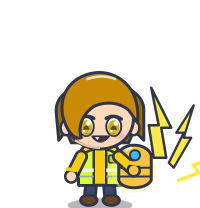
NPCs & rule cards
Solar & EV Rules Sprite
South-facing and statute-backed!
Relentlessly sunny. Loves HOA meetings because she always brings the statute.
Official rules in silly-simple words. Tap a card to flip it. Not legal advice: check with your local office.
In Florida, deed restrictions and HOA/condo rules can't prohibit solar collectors on buildings. The association CAN pick where on the roof, if it faces south (or within 45° east/west of south) and doesn't hurt how well it works.
Tap to flip ↻Fla. Stat. §163.04(2): a deed restriction, covenant, declaration or similar binding agreement may not prohibit or have the effect of prohibiting solar collectors, clotheslines or other renewable energy devices on buildings; a property owner may not be denied permission by an entity with approval power, but the entity may determine the specific roof location within an orientation to the south or within 45 degrees east or west of due south if it does not impair effective operation.
§163.04 Energy devices based on renewable resources (2026 Fla. Stat.)
F · LCities and counties can't adopt an ordinance that prohibits (or effectively prohibits) solar or other renewable energy devices.
Tap to flip ↻Fla. Stat. §163.04(1): adoption of an ordinance by a governing body which prohibits or has the effect of prohibiting the installation of solar collectors, clotheslines or other energy devices based on renewable resources is expressly prohibited.
§163.04 Energy devices based on renewable resources (2026 Fla. Stat.)
F · LFlorida has a 'solar contractor' license category for PV, solar water heating and pool solar. Check the installer holds the right license.
Tap to flip ↻Fla. Stat. §489.105(3)(o): 'solar contractor' means a contractor whose services consist of installation, alteration, repair, maintenance, relocation or replacement of solar panels for potable solar water heating systems, swimming pool solar heating systems and photovoltaic systems and related equipment.
§489.105 Definitions (contractor categories) (2026 Fla. Stat.)
F · LFlorida treats EV charging by non-utilities as not 'selling electricity', and regulation of charging stations is preempted to the state. Translation: the rules mostly come from Tallahassee, not your town hall.
Tap to flip ↻Fla. Stat. §366.94(1)-(2): provision of EV charging to the public by a nonutility is not the retail sale of electricity under chapter 366, and its rates, terms and conditions are not regulated under that chapter; 'electric vehicle charging station' is defined, and the regulation of electric vehicle charging stations is preempted to the state.
F · LNobody by that name. Try another word.